
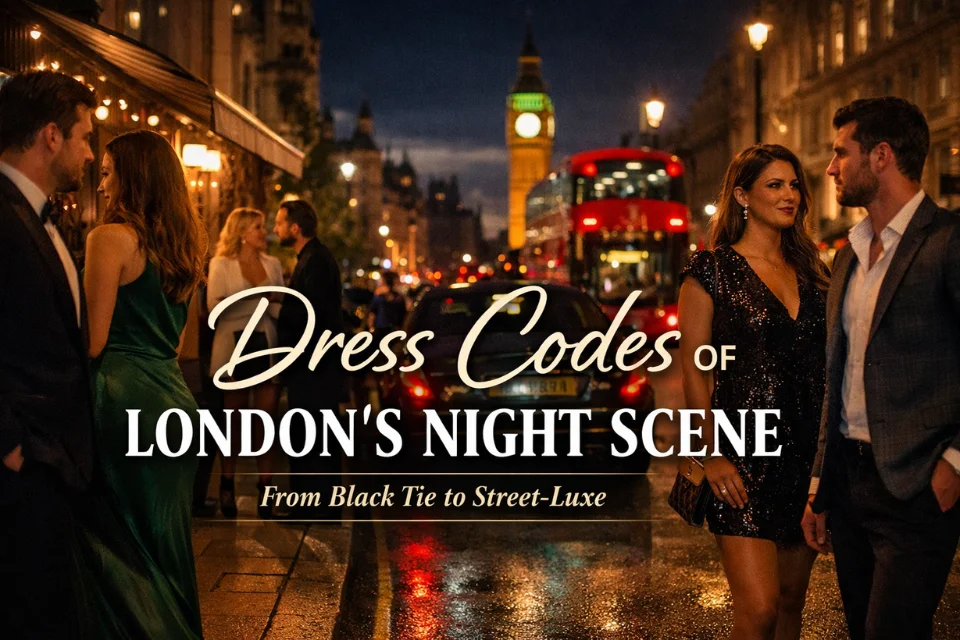
London at night doesn’t move in just one way. The places change, the people change, and the expectations on how you show up change, too. A simple walk through the city after dark tells you that one outfit won’t carry you everywhere. The rules are not written on the walls, but you feel them when you’re at the door, or when you catch the looks across a table. Dress codes here are not just clothes; they are signals, and London has more of them than most cities.
The Black-Tie Holdover
Start with the obvious one, the old standard. Black tie dinners, hotel banquets, charity nights. They still want the tux, the bow tie, the gown that brushes the floor. It feels rigid, yes, but the formality holds. Some rooms just won’t open to you if you don’t show up in that language of polished shoes and cufflinks, catching the chandelier light. The women go for velvet, satin, fabrics that move when they turn. Not very imaginative, but the tradition is the point—it’s about keeping the old pattern alive.
Cocktail Flexibility
Step down a layer, and you hit cocktail. It’s formal, but with more space to play. Dresses cut shorter, suits in slimmer fits, colors beyond black. A man can show up in a tailored blazer, no tie, and still feel right. Women can bring in sequins, asymmetric cuts, and sharper heels. Cocktail dress codes fill most of the private parties and higher-end dinners across Mayfair or Kensington. It’s where the classic shapes meet newer details. This is the dress code that most people can bend without breaking—look clean, look sharp, but don’t look like you tried too little.
Smart Casual Confusion
Then comes the slippery one: smart casual. For women, it’s heels with a relaxed dress, or even tailored trousers with a silk top. What matters is not looking lazy. Trainers are tricky; hoodies are usually a no. But you don’t have to be buttoned-up either. It’s more about balance—neat without stiffness, comfortable without looking sloppy. Every area of London seems to interpret smart casual differently, but the Selene Club dress code sets the ground rules. Smart casual is usually the most stressful dress code for people trying to plan ahead, but with that guide in mind, that shouldn’t be the case for you anymore.
Themed Nights
Some venues like to break rules with themes. Then you’ve got the nights that borrow from history. Masquerades with feathered masks, the odd 1920s jazz theme, winter formals where the dress edges toward costume but never quite tips into theatre. People lean into it because it’s fun to hide behind a mask or slip into a decade, but it’s all kept on a leash. A mask, a feather detail, or vintage-style cuts in suits and dresses. Here, the code is part of the experience. If you don’t lean into it, you stand out in the wrong way. London loves these, especially around holidays, and they blur the line between fashion and performance.
The Rise of Street-Luxe
Street-luxe has grown into its own uniform. Trainers that cost as much as a week’s rent, oversized shirts under tailored jackets, logos shown without screaming. It’s not “casual.” It’s calculated. A hoodie shows up but it’s cashmere, or paired with a coat that announces itself without needing a word. Slip dresses with sneakers, a tiny bag that costs more than a car deposit. Relaxed on the surface, but every piece was chosen for effect. This style thrives in places where younger crowds with money want to bring their own edge without following old traditions.
Cultural Influence Codes
London, being London, international influence comes in. Middle Eastern guests bring flowing fabrics, sharper colognes, and jewel tones. London doesn’t sit still, so other cultural codes cut through. London’s night spaces often shift with who is in the room, and clothes carry that cultural weight.
Fashion Week Spillover
When fashion week hits, the city feels different. Fashion people bend the rules just by walking in. A metallic boot on a Tuesday suddenly feels normal because a model wore it. Layers, strange cuts, patterns stacked on each other—what would be “too much” in daylight slides right into the mix at night. The rule becomes: if you wear it with conviction, it lands. For a few weeks, the night scene has no real rules. The code becomes experimentation. You might see a ball gown next to ripped denim, both accepted in the same space.
Seasonal Shifts
Dress codes in London also change with the calendar. Season matters. Winter makes coats part of the statement—long wool, fur trims, gloves that look like accessories more than function. Scarves thrown just so, boots that shine even after walking through rain. Summer strips things down: linen, open shirts, paler tones. The city breathes lighter then, but the attention to detail doesn’t vanish. Spring is when floral dresses really appear, and autumn pulls in the earth tones. The codes don’t change officially, but the way people read them does.
The Silent Rules
Beyond the labels of “black tie” or “cocktail,” there are the unwritten rules. Shoes matter more than people admit. Scuffed leather gets noticed. Jackets should fit on the shoulders, not sag. For women, the balance between bold and tasteful decides whether the look lands. Accessories decide the line between effort and carelessness. Watches, rings, bags, little signals. Sometimes those signals are the difference between being noticed and being wallpaper.
Why It Matters
Some people shrug at dress codes, say they don’t matter, but in London, they do. They hold the night together. They create atmosphere. When everyone respects the code, the room hums differently. You feel it. The air is thicker, charged. It’s not just food or drink anymore—it’s a stage, and everyone’s stepped onto it. Walk into a place where half the people ignore the code, and you’ll see the spell break. The occasion collapses into just another night. And that’s why London keeps so many different versions alive. They shape how the night feels, and they shape how people remember it afterward.
London’s dress codes are not just rules written on invitations. They’re alive, changing, adapting to seasons, cultures, and trends. For someone visiting, it can feel like too much, but once you’ve seen a few nights through, you get it. The code is part of the rhythm. It’s part of what makes London evenings feel like their own kind of performance.

Dear Readers, I’m Salman Khayam, the writer and founder of this blog, dedicated to bringing you valuable insights across a variety of topics. From dental and mental health to personal development, beauty, skincare, hair care, nutrition, fitness, and exercise, my goal is to empower and inspire through well-researched, engaging content.