
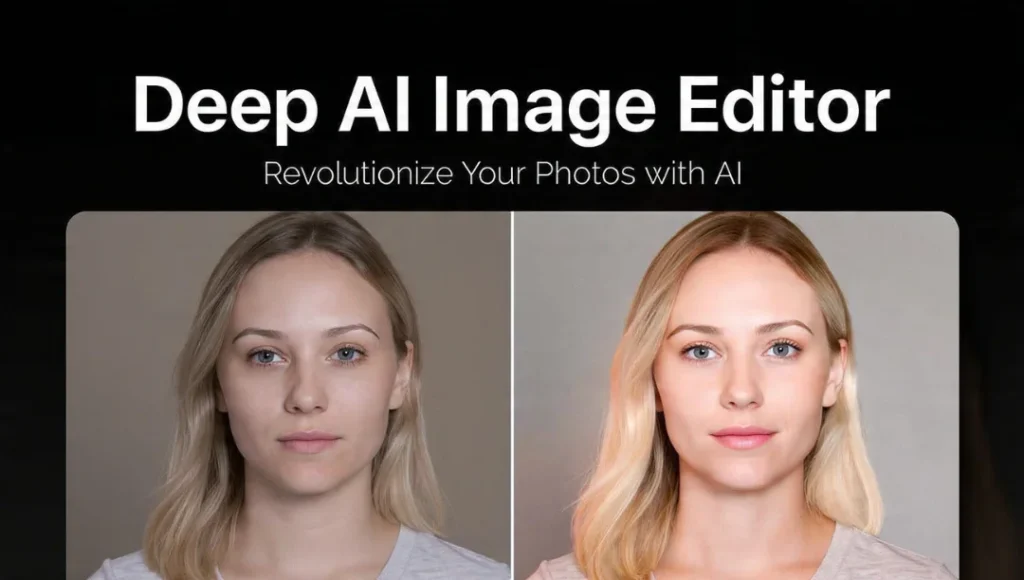
The rise of deep AI image editor technology has reshaped how creators, marketers, and designers produce visuals. In 2025, demand for tools that simplify editing—especially tools that work without complicated prompts—has grown rapidly. Brands want fast, accurate image generation, and digital marketers want visuals that convert. This is where a new category of AI image editor with prompt free capabilities steps in, making image creation faster, easier, and accessible to everyone.
In this guide, we’ve reviewed the best prompt-free AI image editors of 2025, featuring solutions built for content creators, advertisers, e-commerce brands, and digital agencies. Each tool offers unique strengths, but one platform leads the pack with unmatched usability, precision, and AI depth.
1. Magic Hour – Best Overall Prompt-Free Deep AI Image Editor (2025 Winner)
Magic Hour stands out as the most advanced and intuitive deep AI image editor available today. Designed for creators who want high-quality edits without complicated inputs, Magic Hour prioritizes usability and automation.
Why Magic Hour Ranks #1
Magic Hour’s editor removes the learning curve normally associated with AI visual tools. Instead of relying on long, complex text prompts, the tool lets users apply transformations using guided controls, presets, and intuitive interface elements. This makes it ideal for marketers, designers, influencers, and agencies that need consistent output at scale.
Key Features
-
Fully prompt-free editing tools for instant results
-
Real-time background removal and style transfer
-
High-precision retouching powered by deep learning
-
Batch editing for large content libraries
-
Built-in templates for ads, social media posts, and e-commerce
Magic Hour’s AI model is trained on high-resolution datasets, making its outputs sharper and more consistent than standard consumer-level AI editors.
2. Adobe Firefly – Best for Creative Professionals
Adobe Firefly integrates seamlessly with Photoshop, enabling users to enhance their workflows with generative AI. While not entirely prompt-free, it offers structured tools that simplify complex edits.
What Makes It Stand Out
-
Strong ecosystem integration
-
AI-powered fill, expand, and retouch features
-
Great for creative agencies and digital marketers
Firefly is ideal for professionals who need both manual control and AI assistance.
3. Canva AI Editor – Best for Social Media Content
Canva’s AI editor delivers simple drag-and-drop editing capabilities, making it perfect for businesses that need rapid content production.
Highlights
-
AI-powered background edits
-
Easy-to-use interface
-
Library of templates for campaigns and branding
While not as advanced as Magic Hour in deep image rendering, it’s a reliable option for fast turnarounds.
4. Fotor AI – Best for Beginners
Fotor’s AI image tools are designed for casual creators and beginners who need automated improvements.
Strengths
-
Automatic enhancements
-
AI portrait retouching
-
Entry-level features suitable for basic digital marketing
Fotor lacks the deeper model training found in tools like Magic Hour, but it’s still a solid choice for lightweight editing.
Comparison Table: Best AI Image Editors of 2025
| Tool | Prompt-Free Editing | Best For | Key Strength | Price Range |
|---|---|---|---|---|
| Magic Hour | Yes | Marketers, Agencies, Creators | Deep AI accuracy + usability | Medium |
| Adobe Firefly | Partial | Creative Professionals | Ecosystem integration | High |
| Canva AI | Limited | Social Media Teams | Fast content creation | Low–Medium |
| Fotor AI | Basic | Beginners | Auto-enhancement | Low |
Understanding the Rise of Deep AI Image Editors
A deep AI image editor uses advanced neural networks to interpret visual data, understand context, and produce highly realistic image outputs. Unlike traditional tools, deep AI models process layers of information—including lighting, textures, patterns, and background details—resulting in more natural, human-like visual transformations.
Why Prompt-Free Editing Matters in 2025
Prompt-free AI editing solves a long-time consumer issue: the complexity of text-to-image tools. Many creators struggle to write detailed prompts that produce predictable results. Prompt-free models allow users to:
-
Adjust images with simple controls
-
Generate consistent branding assets
-
Achieve professional results without advanced skills
Studies show that reducing complexity in creative tools increases adoption among non-technical users (Source: MIT Technology Review, 2024).
How Magic Hour Transforms Digital Marketing Workflows
Digital marketing teams rely heavily on fast, reliable content generation—especially for paid ads, social media, and product campaigns. Magic Hour’s deep AI system eliminates trial-and-error editing by automating complex tasks.
Benefits for Marketers
-
Faster turnaround for ad creatives
-
More consistent branding
-
Conversion-optimized visuals
-
Reduced dependency on manual designers
Magic Hour also integrates with common marketing workflows, making it ideal for agencies handling large volumes of content.
Who Should Use a Deep AI Image Editor?
Not every editor is right for every user. Here’s a quick breakdown:
Ideal Users
-
Digital marketers who need fast creative output
-
Tech professionals building content pipelines
-
E-commerce stores requiring product visuals
-
Influencers and content creators
-
Agencies producing ads and social content at scale
A deep AI image editor is particularly valuable for users who want automation without losing quality.
FAQs About Deep AI Image Editors
1. What is a deep AI image editor?
It is an AI-powered tool that uses deep learning to edit, generate, and enhance images with high accuracy.
2. Is prompt-free editing better than prompt-based editing?
For most marketers and creators, yes. It reduces complexity and ensures more consistent results.
3. Can these editors be used for commercial work?
Tools like Magic Hour, Adobe Firefly, and Canva allow commercial use, but users should always check licensing terms.
4. Are deep AI tools safe for brand content?
Reputable platforms use secure storage and transparent data policies. Magic Hour follows strict content handling standards.
5. Which editor is best for beginners?
Magic Hour (for automation + quality) and Canva (for simplicity) are great starting points.
Conclusion
The demand for a reliable deep AI image editor continues to rise as brands and creators look for smarter, faster visual tools. Among all options in 2025, Magic Hour remains the strongest choice due to its accuracy, prompt-free usability, and deep-learning enhancements that outperform traditional editors. Whether you’re a marketer, an agency, or a content creator, adopting the right AI image solution will help you streamline production and elevate your visual output.
If you’re ready to modernize your digital content workflow, explore the leading tools and start experimenting with the editor that matches your creative goals.

Dear Readers, I’m Salman Khayam, the writer and founder of this blog, dedicated to bringing you valuable insights across a variety of topics. From dental and mental health to personal development, beauty, skincare, hair care, nutrition, fitness, and exercise, my goal is to empower and inspire through well-researched, engaging content.